Agents+5Oct 8
Image: cloud.google.com
Google launches a Gemini agent for long-running business work
Google launched a Gemini business agent that can work through documents, calendars, code and company data for hours or days. The cloud-based agent connects to business applications and databases, retains memory, writes and runs code, and delegates to subagents (other agents assigned parts of the job). Businesses can choose Gemini or Claude models. Administrators can set sharing permissions, select models and cap spending; coworker agents have their own accounts, email addresses and activity logs.
Agents+5Oct 9
Image: openai.com
Asana updates StackAI after tests cut model costs 76-fold
Following 144 test runs checking cost, runtime and answer correctness, Asana released changes to its StackAI browser agent today. GPT-6 Astra conducted the study in Codex, mapping the code and building controlled experiments that led to tickets and proposed code changes under human review. Asana expanded browsing-history budgets and prompt caching (reusing previously processed input), and added batch screenshot removal; caching alone cut GPT-6.1 Sol costs fourfold. The optimized Sol workflow completed every tested task correctly at an estimated $0.47 in model costs and about four minutes per run, 76 times cheaper and five times faster than the original production-model workflow.
Compute & Infra+5Oct 8

Image: developers.googleblog.com
Google releases ML Drift to speed up on-device AI
ML Drift is available for developers to download and modify, letting them support on-device AI across different graphics chips through one engine. Google released it under Apache 2.0 as both LiteRT's GPU engine (meaning it runs AI work on a device's graphics chip) and a standalone library supporting the OpenGL ES, OpenCL, Metal and WebGPU graphics interfaces. Google is directing developers away from the legacy TFLite GPU delegate (the component that assigns AI work to graphics hardware), which will receive no new features. Google reports up to 40% lower average frame-processing delay for YouTube Shorts effects, up to 30% faster Adobe mobile AI editing and 30% lower model-processing delay for Snapchat effects.
Science+5Oct 8

Image: The Threshold Report/GPT Image 2.5
HuggingFaceBio releases Carbon-A and 566 million predicted gene regions
Carbon-A is available to download for finding protein-coding regions directly from DNA, including in poorly studied organisms. HuggingFaceBio's model has 1.2 billion parameters (learned settings) and handles major eukaryotic groups (organisms whose cells have nuclei), reducing dependence on species-specific tools and existing RNA data. Its accompanying database contains 566 million predictions across 48,167 assembled genomes from 22,617 biological groups, with coordinates, reconstructed sequences and confidence scores. Carbon-A scored 0.944 on nucleotide F1 (a measure balancing missed and incorrect DNA-letter predictions) across 42 test genomes, beating the team's comparison models; RNA experiments with ActiveSite and UCSD supported some predicted gene structures missing from RefSeq (a reference-sequence database).
Text+5Oct 8
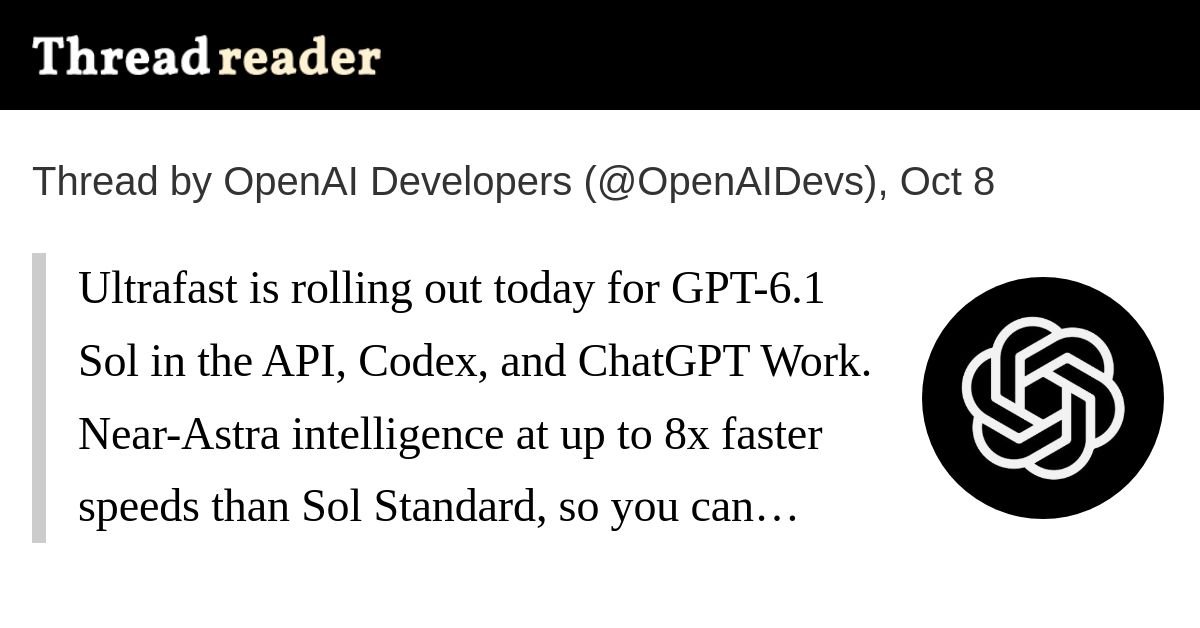
Image: threadreaderapp.com
OpenAI releases a faster GPT-6.1 Sol mode
Yesterday, OpenAI released GPT-6.1 Sol Ultrafast, offering a faster option for coding and app-navigation work. It is available in the API, Codex and ChatGPT Work; Codex and ChatGPT Work access covers Pro 500, eligible usage-based Enterprise and credit-based Edu plans, with Enterprise administrators required to enable it. API prices are $12 per million input tokens and $60 per million output tokens (tokens are pieces of text a model processes), with support for keeping data in the US or EU. OpenAI says Ultrafast approaches Astra's intelligence at up to eight times the speed of Sol Standard.
Audio+2Video+2Oct 6
Image: github.com
Kandinsky Lab releases downloadable audio-video models with lip-sync
Kandinsky 6.0 combines 44 kHz audio (the sound's sampling rate) with matching video and lip movements, and developers can download the models for local production. Text prompts or starting images produce clips lasting five seconds. The Lite and Pro versions contain 3 billion and 29 billion learned values respectively, and a separate enlargement model raises resolution to 1920×1080. Developers get hardware-specific setup, ready-made generation settings, hosting examples and measured runtimes, plus support for Diffusers, ComfyUI, vLLM-Omni, SGLang and FastVideo.
Robots+2Oct 7
Image: github.com
NVIDIA releases Long-WAM for robots that use visual history
On Oct. 7, NVIDIA released Long-WAM code and trained models so robotics teams can test systems that use earlier camera observations. The models build on LongLive's video infrastructure, with tools for learning from robot video, training on benchmarks and running evaluations. Long-WAM supports streaming inference (making decisions as observations arrive), with deployment interfaces for YAM, Franka and Unitree G1 robots. Released variants cover manipulation tests, generalist kitchen tasks and training for two-handed robot work, with runtime profiles for RTX 5090, DGX Spark and AGX Thor.
Text+2Oct 8
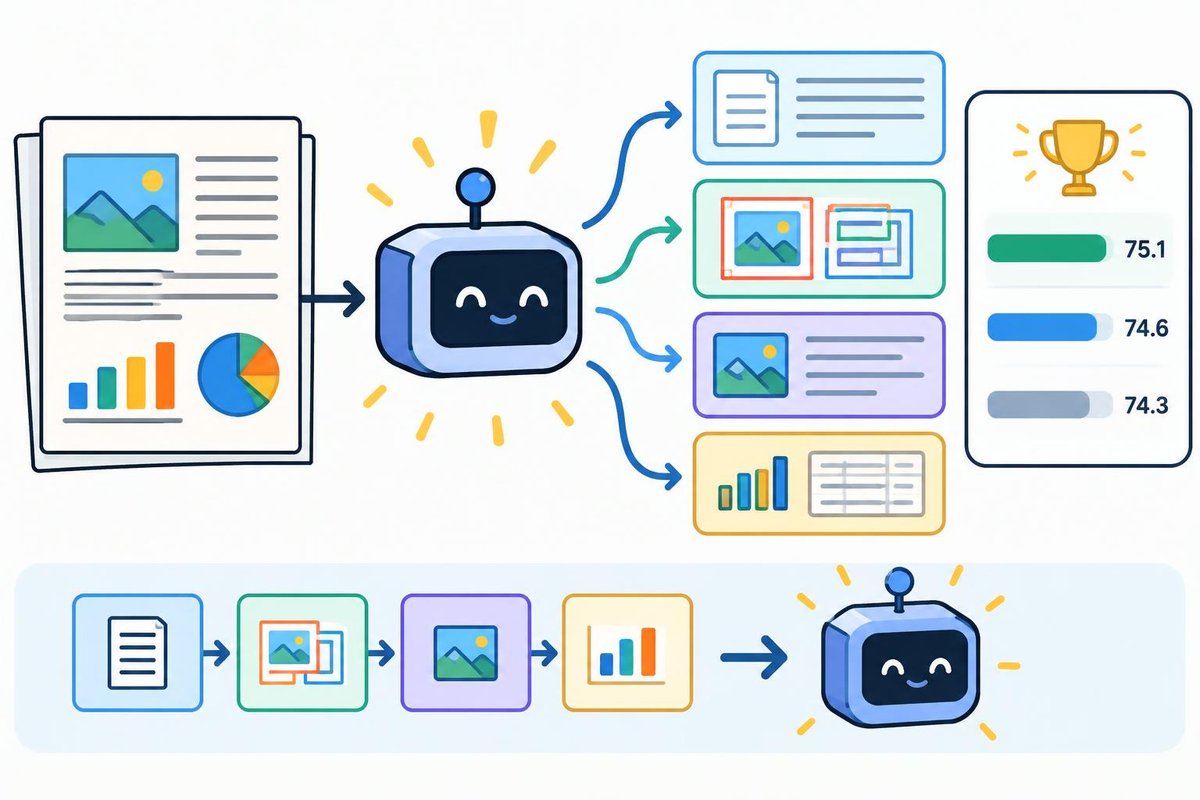
Image: The Threshold Report/GPT Image 2.5
LightOn releases models for reading text, layouts and charts
LightOn released Apache-licensed OCR models (tools for reading text from images) that developers can download to combine document transcription with layout and figure extraction. Models with 0.8 billion, 1 billion and 4 billion parameters (learned values) can optionally return labeled boxes around page elements, image descriptions and chart-data tables. LightOn measured 2.7 seconds to process one page with its 1-billion-parameter model on an H100 graphics chip and published scripts for repeating the evaluations. In LightOn's five-category ParseBench comparison, the 4-billion and 0.8-billion models scored 75.1 and 74.6 overall, ahead of the 35.1-billion-parameter Infinity Parser Pro at 74.3.


